The Pitch
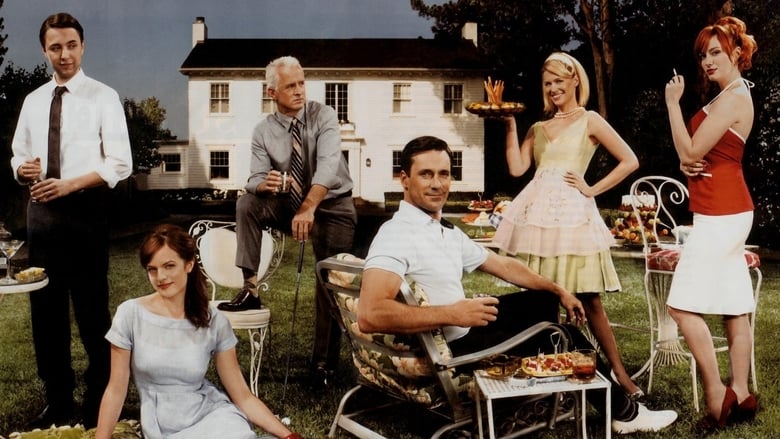
An advertising agency in 1960s Manhattan. Don Draper (Jon Hamm) is the creative director at Sterling Cooper, a firm that sells cigarettes, girdles, and Kodak carousels to a country that hasn't figured out what it wants yet. He's magnetic in the room and unreachable outside it. The pilot establishes early that the Don Draper everyone sees at the office and the man who goes home to a house in Ossining are not exactly the same person, and that the gap between them is the show. Around him: Peggy Olson (Elisabeth Moss) starts as his secretary, Roger Sterling (John Slattery) drinks lunches and runs the place, Joan Holloway (Christina Hendricks) knows where every skeleton lives, Pete Campbell (Vincent Kartheiser) claws upward with a smile you want to slap off, and Betty Draper (January Jones) sits at home in a Grace Kelly freezer. Matthew Weiner, coming off writing on The Sopranos, created it. Seven seasons, ran 2007 to 2015 on AMC.
In Its Favor
Weiner writes scenes that seem to be about nothing and turn out to be about everything. A pitch meeting for a slide projector becomes the most devastating monologue on television. The craft is absurd: Phil Abraham's cinematography, Janie Bryant's costumes, needle drops that land like slaps. Hamm plays a man who is 90% surface and lets you feel every crack in the veneer without ever tipping his hand. Moss's Peggy is a decade-long study in becoming a person on purpose. Slattery gets the best one-liners in prestige TV history and delivers them like he's bored. It's the rare show where the writers trust the audience with silence, subtext, and long looks out windows.
What Doesn't Work
It's slow. Genuinely slow — the plot engine is character drift, not incident, and if you need a body dropped every episode to stay interested, this'll feel like homework. The first four episodes are a vibe more than a hook. Betty's storylines can grate. Don's a bad husband and a worse dad, and the show doesn't punish him on your preferred timeline. Some viewers find the ad-pitch structure repetitive by season three. Fair.
The Right Viewer
If you loved The Sopranos, The Americans, or Better Call Saul — shows where interiority is the whole game — you're already in. If you're here for Yellowstone-style plot velocity, you'll quit by episode two and think everyone lied to you. Anyone who watched Severance and thought "yes, I would like more shows about men whose work self is eating their real self" is the target demo.
Final Word
DROP EVERYTHING is the right call because almost nothing else on television has this ratio of restraint to reward. Weiner's room writes sermons about nothing. The show has strong opinions about race, gender, work, family, and America the product, and it earns every one by putting them inside human beings with contradictions instead of putting them in monologues. When a character says something ugly, the scene doesn't stop so someone else can correct it for the audience; the ugliness sits there and does its work. That's the Lecture Test passed at a level almost no current drama clears. Ambition and execution match. Sit down and let it move at its pace.