What It Is
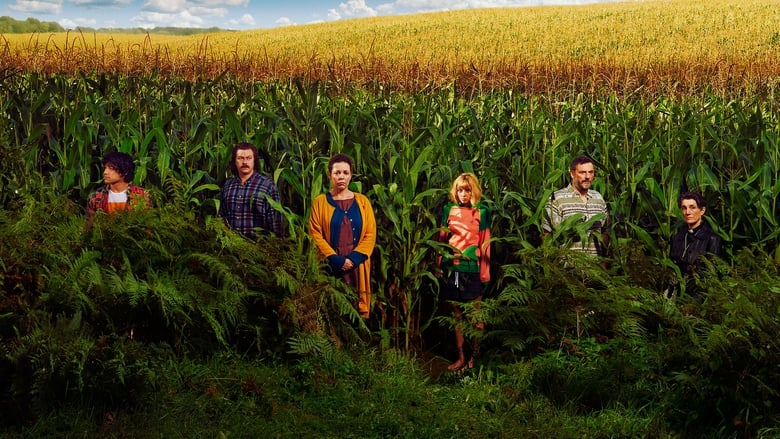
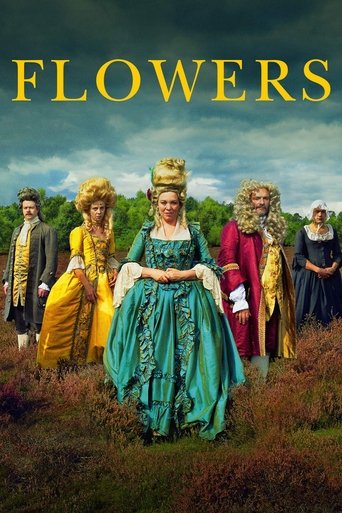
"Flowers" is a British black comedy written, directed by, and co-starring Will Sharpe, running two seasons on Channel 4 (2016 and 2018) and now parked on Prime Video. The setup: the Flowers family lives in a crumbling, ivy-choked house in the English countryside. Maurice (Julian Barratt) is a depressed children's book author who can't finish anything and can barely get out of bed. Deborah (Olivia Colman) is his music-teacher wife, cheerfully unraveling in the next room. Their adult twins still live at home: Donald (Daniel Rigby), an inventor whose inventions don't work, and Amy (Sophia Di Martino), a musician composing something nobody has asked for. Sharpe plays Shun, Maurice's Japanese illustrator and lodger, who narrates his own life in a running mistranslation of English idiom. Early episodes establish the household's baseline: everyone loves each other and nobody can say it, and something is quietly wrong with the man at the head of the table.
What It Gets Right
Sharpe writes and directs every episode himself, and it shows in the tonal control. The house is shot like a Guillermo del Toro storybook, all warped wood and dim green light, but the jokes land like Fleabag on a bad Sunday. Colman does the thing Colman does, where she smiles so hard you can see the crack forming, and Barratt (of "The Mighty Boosh") gives the best straight performance of his career, playing Maurice with a stillness that's almost frightening. Rigby and Di Martino are wonderful as the twins, competitive and codependent in a way that reads as painfully specific rather than sitcom-shorthand. Sharpe himself is the show's secret weapon; Shun could've been an ethnic-outsider gag and instead he's the most emotionally literate person on screen.
Where It Falls Down
It's slow. Six episodes a season, but they move like a Sunday afternoon that won't end. The comedy is real but it's buried, and if you need a laugh every ninety seconds you'll be checking your phone by episode two. Season one earns its darkness; season two swings for something bigger and occasionally trips over its own ambition, particularly a mid-run detour that some viewers will find brave and others will find self-indulgent. The whimsy dial is turned up further than a lot of American audiences will tolerate.
Who It's For, Who'll Bounce
For you if you loved "Fleabag," "Fishing With John," early Wes Anderson, or "Lars and the Real Girl." For you if "depressing but funny" is a compliment. Bounce candidates: anyone looking for prestige-plot machinery, anyone who found "The Bear" too stressful, anyone who thinks comedy means jokes-per-minute. If your favorite thing about a show is the last ten minutes of the finale, this isn't built for you.
The Bottom Line
WORTH IT because Sharpe actually pulls it off. Depression is the hardest subject to dramatize without either romanticizing it or turning it into a PSA, and "Flowers" does neither. Nobody delivers a monologue about mental health. Nobody Googles a diagnosis at the camera. The show trusts you to watch Maurice sit on a bed for a long time and understand what that means, and it trusts Barratt and Colman to carry the weight without an underscore telling you how to feel. That's craft. It's not BEST IN CLASS because the pacing is genuinely a barrier and the second season's reach exceeds its grasp in a couple of places. But it earns every mood it sets. Watch it on a gray day. It will meet you there.