
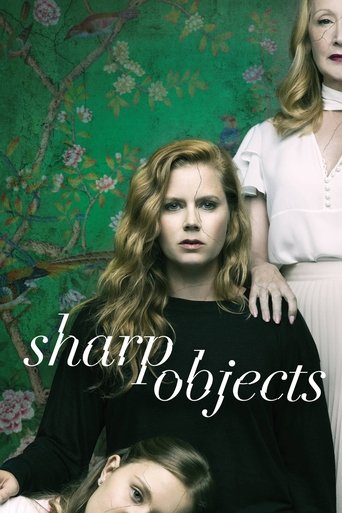
The Premise
Eight episodes on HBO, adapted by Marti Noxon from Gillian Flynn's debut novel, all directed by Jean-Marc Vallée. Amy Adams plays Camille Preaker, a crime reporter with a drinking problem and a history of self-harm, sent back to her hometown of Wind Gap, Missouri to cover the murder of one local girl and the disappearance of another. Home means Adora (Patricia Clarkson), her chilly Victorian-doll of a mother, and Amma (Eliza Scanlen), a teenage half-sister who behaves like porcelain at home and something else entirely once she's out the door. Chris Messina is the out-of-town detective circling the case.
In Its Favor
Adams is doing the best dramatic work of her career here, and she barely says anything. Camille communicates in eye flicks, small swallows of vodka poured into whatever container is handy, and the tight body language of someone who wears long sleeves in July for a reason. Clarkson is a wonder — a mother whose weaponized politeness makes you understand why her adult daughter drinks in parking lots. Scanlen's Amma, roller-skating around town like a Chekhov gun in kneepads, is one of the great teenage-girl performances of the decade. Vallée directs it the way he directed Big Little Lies but darker and drunker, cutting on sound and memory instead of scene, so the whole thing plays like Camille's hangover. The needle drops (a lot of Led Zeppelin, some regrettable Franz Ferdinand) live inside her headphones, not on top of the scene. And Wind Gap itself — the hog plant, the pageant girls, the porch-drinking gentry — is a fully built Southern Gothic world.
Where It Falls Down
It is slow. Not slow-burn slow, molasses-in-January slow. If you want a mystery that advances every week, you'll want to throw the remote. Vallée's flashback style — a face, a bathtub, a word carved somewhere, gone — is either hypnotic or infuriating depending on your tolerance for withheld information. Camille is closed off by design, which means viewers who need a protagonist to root for will feel locked out. And the "prestige Southern misery" register is thick enough that a bad mood at hour three can tip the whole thing into pretension.
Who'll Love It, Who'll Bail
If you loved Top of the Lake, Mare of Easttown, or the first season of True Detective, you're already in. If your favorite thing about a mystery is the mystery, you'll bounce by episode two and go finish Only Murders instead. It rewards patience and a couch. It punishes multitasking.
The Verdict
WORTH IT because the craft is real and the acting is generational, not because the show is fun. Vallée and Noxon are making a mood piece about inherited female pain wearing the clothes of a whodunit, and they mostly earn it through performance and image rather than speeches. Nobody monologues the theme. Adora doesn't explain herself. Camille doesn't narrate her damage. The show trusts you to read a scar, a smile, a glass of clear liquid. That's the difference between drama and a sermon, and Sharp Objects stays on the right side of it. Watch it drunk, as the blurb said. Watch it sober and it'll still work — you'll just notice how heavy the air is.