The Premise
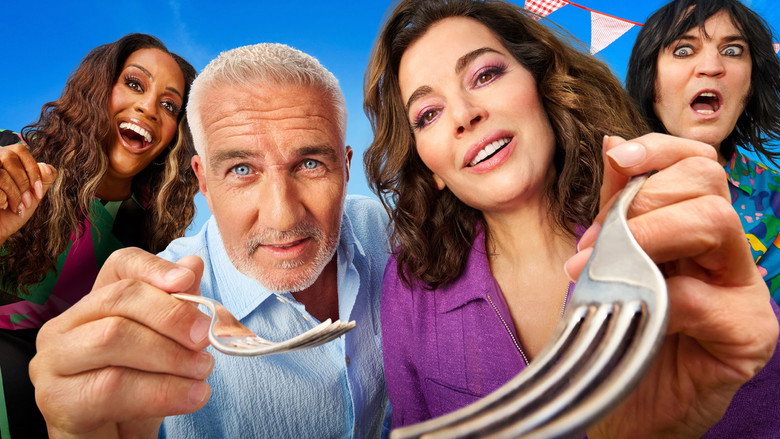
It's a baking competition on a lawn in the English countryside. Twelve amateur bakers pitch up under a white tent, work through a Signature bake, a Technical set by the judges, and a Showstopper meant to look impossible. Paul Hollywood is still there squinting at crumb, and as of the 2026 series Nigella Lawson has taken Prue Leith's chair. Alison Hammond and Noel Fielding host, mostly by wandering around eating raw batter and cracking wise while someone's crème pâtissière splits. That's the whole apparatus. There is no villain edit. Nobody is playing a game. A retired postman just really wants Paul to like his choux.
What Works
The craft is in the edit. Producers at Love Productions have spent fifteen-plus years figuring out how to make three-hour bakes feel like a thriller, and they're good at it. The Technical, in particular, is a small masterpiece of format design: identical recipes, blind judging, ranked results, watch a plumber from Leeds try to divine what a kouign-amann is with no picture. Paul Hollywood's handshake still works as narrative currency because he gives roughly four per season. Noel Fielding treats the tent like a Mighty Boosh sketch and it plays. Alison Hammond hugging a crying contestant is genuinely one of the warmest things on TV. Nigella's arrival is a real swap — she brings actual home-cook credibility where Prue brought pastry-school precision, and early episodes lean into that shift instead of hiding it. The music cues, the tight cutaways to a slumping sponge, the way they'll hold on a hopeful face for a beat too long. Small choices, done well, week after week.
What It Gets Wrong
It's the same show it was in 2010. If you've watched a season, you've watched them all, and the 2026 tweak — an "Audience Choice Week" where viewers vote on the challenges — is exactly as gimmicky as it sounds. The pacing is deliberately slow. There's no jeopardy beyond someone's ganache being a bit loose. Recent seasons have leaned harder on themed weeks (Mexican Week, Japanese Week) that occasionally clang. And Netflix's rollout is annoying: episodes drop weekly on Fridays, a week behind the UK, so if you're online at all you'll get spoiled by a tabloid headline before you finish your tea.
Who Should Watch
If you liked Chef's Table but wanted less ego, or Top Chef but wanted less shouting, this is the exact thing. Fans of Taskmaster will recognize the low-stakes British gentleness. Anyone who needs a body count, a rivalry, or a confessional booth full of grievances will be out by the second Signature. It also works phenomenally as something to fall asleep to, which is either praise or an insult depending on your temperament.
The Sentence
WORTH IT because the craft is quietly excellent and the show knows exactly what it is. The writing (yes, unscripted TV is written — in the edit, the challenge design, the running order) has a rhythm it has earned over a decade and change. Nobody is being lectured at. Nobody is lecturing. The politics of the show, to the extent it has any, is that people from every corner of Britain can stand next to each other and bake a Battenberg, and it lets that stand on its own without a single monologue about it. Themes carried by story, not megaphone. The ambition is modest and the execution is near-perfect for what it's trying to be, which is the whole ballgame. Not great TV. Good TV, reliably, for a very long time. That's WORTH IT.