
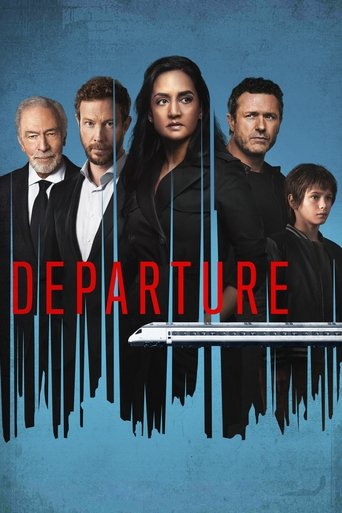
The Premise
"Departure" is a Canadian-produced procedural that landed on Peacock in 2020, created by Vince Shiao and directed by T.J. Scott. Archie Panjabi plays Kendra Malley, a transportation-safety investigator called back to work after a personal loss to figure out why a commercial jet, Flight 716, vanished mid-air. Christopher Plummer plays her old mentor Howard Lawson, who drags her out of grief and into the black-box weeds. The first episodes are a straight-up crash investigation: wreckage pulled from the sea, passenger manifests, tense press conferences, one boss who wants answers yesterday. Season two swaps the plane for a runaway high-speed train. Season three, a submarine. The format resets, the leads don't.
What Works
Panjabi is the reason to press play. She did seven seasons on "The Good Wife" learning how to look like she's thinking three moves ahead of everyone in the room, and she puts all of it into Kendra — quiet authority, visible grief, the specific tiredness of a woman who's the smartest person on scene and knows saying so will cost her. Plummer, in one of his final performances, is doing the velvet-glove thing he perfected fifty years ago, and the two of them together generate more voltage than the writing deserves. Scott shoots the crash-site and wreckage-lab sequences with real texture — cold blue investigation rooms, orange emergency lights, hands sifting scorched metal. When it commits to the procedural bones (interview a witness, pull the flight data, run the sim), it's engrossing in the way "Air Crash Investigation" is engrossing, only with movie stars.
The Argument Against
The mystery machinery around the procedure is where it wobbles. Every season eventually reaches for a conspiracy bigger than the crash itself, and the reach almost always exceeds the writers' grip. Supporting characters are thinly sketched — you can feel the show cycling suspects on a schedule rather than letting anyone breathe. The dialogue leans exposition-heavy; people announce what they're doing while doing it. And the episode-to-episode pacing sags in the middle stretch of every season, where a taut four-parter has been inflated to six.
Who This Is Actually For
If you liked "Manifest" before it got weird, "The Sinner," or any latter-day BBC six-parter where a British-accented professional stares at evidence boards, you're the target. Fans of "Mayday"/"Air Disasters" who want dramatized versions with stars will eat it up. Anyone who needs the propulsion of "Slow Horses" or the writing sharpness of "Line of Duty" will tap out by episode two, when someone explains a black box out loud to a colleague who obviously knows what a black box is.
Final Word
BACKGROUND TV is exactly right because the show's ambition sits a full weight class above its execution. The premise (elite investigator, mode of transport, ticking clock) is a machine that runs itself; Panjabi and Plummer are giving you feature-film performances inside television that shoots and scripts like a solid basic-cable procedural. That gap is the whole viewing experience. It's watchable while you fold laundry, absorbing when you tune in, forgivable when you drift. Nothing here is preachy or trying to sell you a worldview — it's just a competent crash-of-the-week with two actors who deserved a sharper writers' room. Perfect Tuesday. Don't cancel plans.
Sources: