
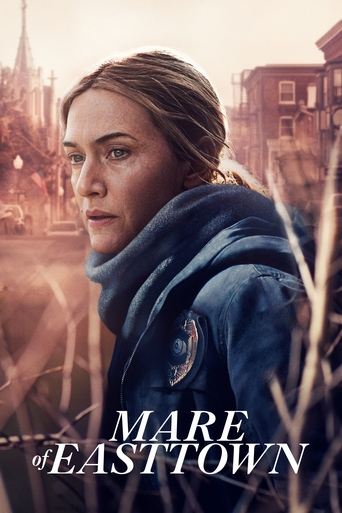
Where This Starts
Seven-episode HBO limited series from 2021, created by Brad Ingelsby and directed top to bottom by Craig Zobel. Kate Winslet plays Mare Sheehan, a detective sergeant in a fictional working-class town in Delaware County, Pennsylvania, who catches a murder case while a year-old missing-persons investigation still hangs around her neck like a bad smell. She lives with her mother (Jean Smart), her teenage daughter (Angourie Rice), and a grandson whose custody situation is complicated. Guy Pearce turns up as a visiting writer, Evan Peters as a county detective assigned to help her, Julianne Nicholson as her lifelong best friend. Early episodes lay out the town, the family, the case, and Mare's very bad coping strategies. That's your first act.
The Argument For
Winslet is doing something specific here — not "prestige actress slums it in a coat," but a full inhabitation of a woman who's exhausted, mean when cornered, funny by accident, and physically wrong for a hero shot in every scene. The Delco accent she wears like a second skin. Jean Smart eats every scene she's in without raising her voice. Julianne Nicholson does more with a pause than most actors do with a monologue. Ingelsby writes local — the hoagie orders, the church basements, the way a small town knows everyone's business and lies about it anyway — and Zobel shoots winter Pennsylvania as a real place, gray and cluttered and lived-in. The score by Lele Marchitelli avoids the usual prestige-mystery dread hum. And the mystery plotting actually plays fair; clues are where they should be.
The Argument Against
It's a mid-tempo grief drama wearing a whodunit costume, and if you came for the whodunit you'll get restless in episodes three and four while the show sits with Mare's family instead. The Delco accents are polarizing; some viewers find them distracting for the whole run. Certain subplots — the visiting-author romance especially — feel imported from a different, worse show. And the mystery, while satisfying if you're invested in the people, isn't reinventing the wheel it's rolling on. If you don't buy Winslet's Mare in the first hour, nothing that follows will change your mind.
Who'll Love It, Who'll Bail
Sticks with: people who liked Happy Valley, Broadchurch, The Killing (US), or Sharp Objects — regional-detective character studies where the case is the excuse. Also anyone who watches for actors, because the actors are the reason. Bounces: viewers who want True Detective season-one metaphysics or a Mindhunter procedural rhythm. Also anyone allergic to family melodrama, because there is a lot of family melodrama, and it is the point.
The Bottom Line
WORTH IT is the right shelf. It's a limited series that knows what size it is — seven episodes, no filler, no bloat, no second-season pressure warping the ending. Zobel's direction is patient without being sluggish; Ingelsby's script trusts the audience to keep track of a lot of names and grudges. Winslet's performance is the kind of thing that justifies the whole enterprise. On the Lecture Test: the show has plenty on its mind about class, addiction, and how a town covers for its own, but it puts all of it inside behavior. Nobody makes a speech. Nobody stops the plot to be admired. The themes arrive because the characters do, which is the difference between a drama and a sermon with production values. Not a masterpiece. Genuinely good. Watch it.
Sources: