
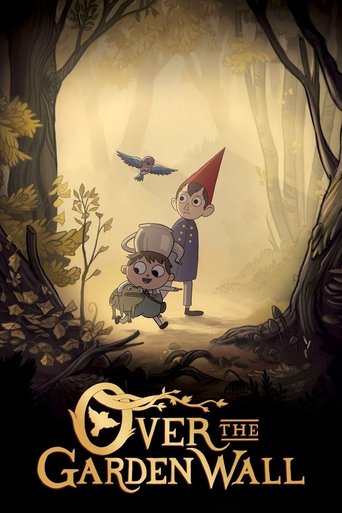
What It Is
Ten eleven-minute episodes from 2014, aired over five nights on Cartoon Network. Created by Patrick McHale, a writer who came up on Adventure Time. Two half-brothers, Wirt and Greg, are lost in a strange forest called the Unknown, trying to find their way home. Elijah Wood voices the anxious older brother. Collin Dean plays the little one, dressed as some kind of animal, carrying a frog. Melanie Lynskey's a talking bluebird who tags along. Voice cast keeps stacking: Christopher Lloyd, Tim Curry, John Cleese, Bebe Neuwirth. Early episodes drop the boys into a town of pumpkin people, then a rich man's tragic dinner party, then a schoolhouse of animal children. Each stop is a self-contained fairy tale with something wrong underneath.
In Its Favor
The animation looks like a 19th-century children's book got soaked in wet leaves. McHale and his art team pulled from Gustave Doré, old harvest illustrations, silent film. The soundtrack by The Blasting Company is closer to a Tin Pan Alley album than a Cartoon Network score: barbershop harmonies, dulcimer, brass. Elijah Wood plays Wirt as a mumbling teenage disaster and it's the best voice work he's done in years. Collin Dean was a real kid actor when they recorded him, so Greg sounds like an actual small child instead of a writers'-room approximation of one. Every episode is its own genre exercise. The pacing's tight because it has to be. Eleven minutes doesn't leave room to coast.
The Case Against
It's slow in a way modern streaming brains struggle with. The first episode gives almost no explanations for anything, which reads as either enchanting or infuriating depending on your patience for atmosphere. Greg's a child, and children in fiction are polarizing, so if a small kid singing nonsense songs about potatoes and molasses grates on you, that door slams fast. The tone shifts from silly to genuinely eerie without warning, and viewers who want their kid content to stay in one lane will feel whiplashed. Some of the songs are aggressively twee.
Who It's For, Who'll Bounce
If you love Miyazaki, old Rankin/Bass specials, the melancholy stretches of The Muppet Christmas Carol, or the moodier corners of Adventure Time, you're home. Anyone who lit up for Puss in Boots: The Last Wish or Klaus will get it. Bounce risk: viewers who need constant plot velocity, anyone allergic to whimsy, and people who put animation on to have something loud in the background while they scroll. This is a lean-in show.
The Ruling
DROP EVERYTHING because it's the rare piece of television that knows exactly what it is and executes it without a wasted second. A hundred and ten minutes total. No filler. No seasons of table-setting. No bloat. McHale had a specific vision, American folk horror as a children's parable, and everyone on the crew served that vision instead of hedging it. The show carries real themes about brotherhood, fear, and growing up, and it carries them by putting the brothers through the story, not by pausing so anyone can explain what the story means. Nobody monologues. Nobody breaks the fourth wall to be agreed with. The craft does the work: production design, songwriting, voice performance, and a director who trusts his audience to sit in a mood. Twelve years on, it's the show autumn people press into each other's hands every October, and there's a reason. It's the compromise pick that wins the whole room because it wasn't compromised to make it.